

There are times when your cat seems to be moaning, almost crying, and it goes on until it becomes worrying or problematic. This can occur under special circumstances or seemingly for no reason, day or night, in this case compromising everyone’s rest. Yet when asked, “What’s wrong? What are you trying to tell me?”, kitty cannot give you a satisfactory answer.
There are some cats that are naturally more talkative than others, but if your cat is neutered and has increased the frequency and intensity of his meowing or if his tone seems to betray a malaise, the first step is therefore to contact the vet and carry out diagnostic tests, which you may be advised to carry out to rule out physical or neurological problems or pain states.
If your cat is perfectly healthy but the meowing continues, there could be an emotional, relational or environmental problem or one resulting from an incorrect routine. My counselling will help you understand what the source of this problem is, identify possible courses of action for you and your cat and apply them methodically, so that you can help your kitty find satisfaction for its needs and give peace of mind to your ears and your nights.
Write a message to info@aliceguardaigatti.it or fill in the form.
I will get back to you as soon as possible!
WHY DO CATS MEOW?
Acoustic communication is one of the modes of communication of the cat, one of the most ‘vocal’ carnivores in nature. It is widely believed that cats only meow with humans or that this type of vocalisation evolved as a form of communication reserved for humans. Although it is nice to think we are so important, this is not entirely true.
Cats also use vocalisations to communicate with their own kind, not only in conflict or mating situations, but also to seek them out, to greet them, to attract attention. It is certainly true that wildcats meow much less than domestic cats (except in the mating season) and have an inferior repertoire of vocalisations. Cats have to meow with us because they have realised that it is the most effective way of obtaining responses: their more subtle language, such as postural and olfactory, while very eloquent for their fellow humans, is much less so for us humans, who are often busy with our eyes fixed on screens. Many cats, living with us, will thus refine their vocal skills to the point of creating special meows for each situation or request in a kind of intimate and exclusive language that only that cat’s human will be able to decipher. Other cats, on the other hand, tend not to meow at all. Both of these behaviours are to be considered normal.
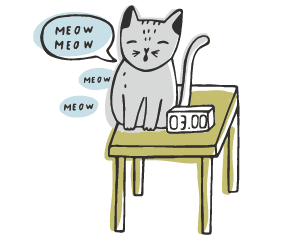
MY CAT ALWAYS MEOWS AND/OR MEOWS AT NIGHT: WHAT TO DO?
If your cat meows too much it is good to consider several factors, for example:
- the circumstances of onset of the behaviour;
- its frequency;
- any triggering factors;
- the type and timbre of meowing;
- whether the meowing is associated with other behaviour, such as wandering around the room or staring at a certain object or person;
- whether other changes in the cat’s health status, environment and routine have occurred.
In the case of hyper-mobile cats, I also recommend that their humans do a little soul-searching: how do we respond to the cat’s vocalisations? The more we engage in conversation with our cat or accommodate it in its ‘verbal’ requests, the more we reinforce this behaviour.
Medical causes of excessive vocalisation may, on the other hand, include a painful condition due to trauma or organic or neurological disorders. Before unnecessarily alarming yourself with exhausting Internet searches, it is better to call your vet directly and schedule a check-up, which may include various diagnostic tests.
THE 10 BEHAVIOURAL REASONS WHY YOUR CAT KEEPS MEOWING
If your cat is in perfect health but still needs to ‘make itself heard’, there could be several reasons. Among the most frequent ones I encounter in my consultations are:
- A biological clock set for the early hours of the morning: the cat is a crepuscular animal, so it is perfectly normal for it to be more active at dawn and dusk (but strategies can be found to bring our biorhythms into alignment).
- Forms of anxiety, from closed-place anxiety to separation anxiety: the cat may meow in the absence of the reference person or to look for them if you are in another room.
- A change of environment: in the case of a move, in the case of newly adopted cats (perhaps from catteries) or cats used to living outdoors (and now moved to a flat).
- A change in routine: for professional or personal reasons, the person or family changes their habits and the cat accordingly.
- Human training: Cats that have instructed their humans to respond to their calls or that depend on them to get what they want (attention, food, going out on the balcony, etc.) will do so under all circumstances, without of course bothering them.
- An excess of energy accumulated during the day that needs to be expressed.
- The loss of a family member being ‘sought after’.
- The presence of another cat or animal outside.
- Meowing can only be a form of self-expression: meowing for the sake of it!
- The cat is trapped in the cupboard or has an urgent request to make!
WHAT NOT TO DO WHEN A CAT MEOWS TOO MUCH
- Do not ignore the cat without making sure there is no problem. Even if you don’t want to reward the meowing, sometimes the cat calls you for a good reason: maybe he can’t reach the litter box, he is trapped in a room, the water bowl is empty. Check him when he meows to determine whether it is something you can safely ignore or a problem that needs to be solved immediately.
- Do not punish the cat for meowing. Hitting, shouting or pushing the cat away are counterproductive solutions, which risk increasing the cat’s anxiety (and thus, its meowing!).
- Do not confine your cat to a room. this will prevent you from hearing your cat but will not solve the problem at the source of the meowing.
What to do? If your vet has established that the meowing is not due to physical reasons and you do not know why else your cat is always meowing, or if you suspect it but still have no idea how to resolve the situation, it is time to contact a cat behaviour and relationship specialist.
SOLVE THE PROBLEM OF EXCESSIVE VOCALISATIONS
As a Feline Relationship Counsellor and Animal Floritherapist, I will help you identify the causes of excessive vocalisations, analysing the environmental and relational context in which you and kitty are immersed, your habits and your way of communicating in order to find practical and targeted solutions. Alongside a plan of action and targeted tasks, I will prescribe a treatment with specific flower essences to balance kitty’s and the family’s emotional sphere and direct it towards the desired change.
1 - THE FIRST CONTACT

Write me an e-mail using the contact form or at info@aliceguardaigatti.it and tell me why you need my help: I will get back to you for a brief chat. If the case falls within my competence, we will make an appointment for a home visit.
Do you live outside Lombardy or is it not possible to meet? No problem, a video consultation can be arranged.
2 - VISITING YOUR HOME

The time has come to get to know each other! I will come to your home and here the case study will begin, which will last between 1 and 2 hours. The visit comprises 3 moments:
- Listening: you will tell me everything you know about your kitten or kittens, their history and your cohabitation.
- Observation: I will ask you to show me the house to collect clues and study it through the eyes of a cat…
- Discussion: I will give you my initial thoughts on the case and the first steps to be taken, weighing up the pros and cons and feasibility together.
3 - A TAILOR-MADE PLAN

Thanks to the impressions and information gathered through observation of the animal, the family and the environment, and after analysis of materials that you will send me (diaries, videos, photos and materials about your cat), I will share with you all the advice and recommendations to follow for a new life with kitty.
Here I will need maximum co-operation and commitment from the whole family to be able to achieve good results together!
4 - HOW IS IT GOING?

It has been a few weeks, how is the situation with your feline companion evolving? Some time after the visit, 14 to 30 days depending on the case, we will get in touch for a new discussion.
We will take stock of the situation, understand what is working and discuss any changes or adjustments to the initial plan.
If you are ready to improve your relationship with kitty or take on a new challenge together, write to me!